Early Christian Community
Quo VadisThe Early Christian Community is both a fellowship of believers and a practical network operating within Nero’s Rome. Its members share prayer, counsel, and the risks of protecting one another; their influence becomes visible in Lygia’s flight, in the attempt to find her through Christian contacts, and in the public reactions to the persecution that follows the Great Fire. The community’s story places forms of mutual aid beside the city’s systems of household ownership, political favor, and imperial punishment.
Identity and Mutual Support
The community is introduced through Lygia’s conviction that hatred is forbidden to her because she is a Christian. When Acte asks whether Christian teaching permits one person to cause the deaths of others, Lygia answers no. Her faith therefore shapes not only private devotion but also the limits she places on Ursus’s desire to retaliate against those who threaten her. The exchange makes Christian belief a practical discipline: protection must be sought without turning into vengeance or bringing destruction upon Aulus and Pomponia.
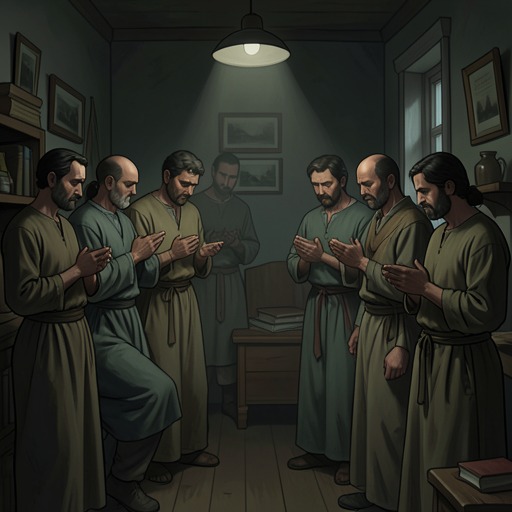
Prayer gives this ethic a visible form in Nero’s palace. After Acte urges Lygia to ask Vinicius to return her to Pomponia, Lygia instead kneels to pray, and Ursus eventually kneels beside her. Acte has never witnessed such a prayer. Watching Lygia, she begins to imagine that help may come from a power even Caesar cannot resist. The scene makes a Christian practice present in a place Acte associates with crime and infamy, and it changes her understanding of the people whose faith she had previously encountered only through report.
The community’s support is not confined to worship. Lygia’s plan is to have Ursus seek Bishop Linus for advice and assistance; she expects him to call Christians to help carry her away and hide her beyond Rome’s reach. Ursus, who has been unable to devise a plan alone, welcomes the task. He believes he can assemble a large company from among acquaintances who are slaves, gladiators, and free people in the Subura and across the bridges. The episode portrays Christian solidarity as an organized capacity to act across social positions, even though the rescue remains a plan rather than a guaranteed outcome.
Protection, Networks, and Exposure
Christian relationships also shape the characters’ expectations of where help can be found. Petronius tells Vinicius that Aulus respects him partly because he has not behaved as an informer, and agrees to speak with Aulus when he returns to Rome. Later, when Lygia is taken to Nero’s palace, Petronius arranges for her to be entrusted to Acte, noting that Pomponia has written to Acte as well. These appeals and arrangements belong to Rome’s personal networks of influence, but they place Lygia’s safety in the hands of people whose loyalties and authority have limits.
Chilo recognizes that Christian ties may frustrate the search for Lygia. He warns that Christians could be among Vinicius’s own slaves and might hinder the search rather than assist it. He proposes concealing his investigation from Eunice and Vinicius’s household, while presenting a false pretext for his work. To identify the fugitives, he describes having questioned people across the city and traced the fish sign associated with Christians. The episode shows the community’s recognizable mark becoming both a means of discovery and a vulnerability: the same sign that can connect believers gives an infiltrator a route into their network.
The community’s efforts to protect Lygia stand in contrast to the resources Vinicius can offer through elite patronage. When she is imprisoned, he approaches Augustians for help and offers Tigellinus his estates in Sicily and whatever else he might demand. Tigellinus refuses, apparently unwilling to offend Poppaea. Vinicius’s wealth and court access cannot compel a favorable decision, while the Christians’ assistance depends on personal trust and collective action. Neither network is secure under Nero’s rule, but the contrast shows how different their resources and obligations are.
The Great Fire and Public Disorder
The Great Fire turns Rome’s urban spaces into a landscape of flight, crowding, and broken authority. As Vinicius approaches the city, the Appian Way is clogged with people; houses, gardens, fields, cemeteries, and temples serve as places of refuge. At the temple of Mars near the Porta Appia, people break down the doors to enter, while conflict over shelter in cemeteries escalates. The account depicts not simply a burning city but a crisis in which familiar distinctions of law, family, and social position cease to govern conduct.
The disorder also arises from the movement and collision of populations. Gladiators who have taken wine from the Emporium roam the surrounding squares, while enslaved people escape from the city’s stalls and join long-established urban slaves in the upheaval. Some among the crowds treat the catastrophe as an opportunity to escape bondage or seek revenge; others flee with what they can save. The fire draws people from nearby towns and the countryside toward Rome, even as residents stream out through the gates. This convergence of evacuation and opportunistic arrival intensifies the breakdown of public order.
Rumor turns catastrophe into political accusation. New fires appearing far from the principal blaze lead observers to suspect deliberate action, but the cause is not established in these scenes. People propose supernatural explanations, while the most widespread rumor says Nero ordered Rome burned to clear away the odors of the Subura and build a new city called Neronia. The rumor fuels popular anger, yet it remains a report circulating amid uncertainty rather than proof of responsibility. Against that confusion, the later effort to identify Christians as the guilty party gives the crisis a target that can be publicly named and punished.
Persecution and the Arena
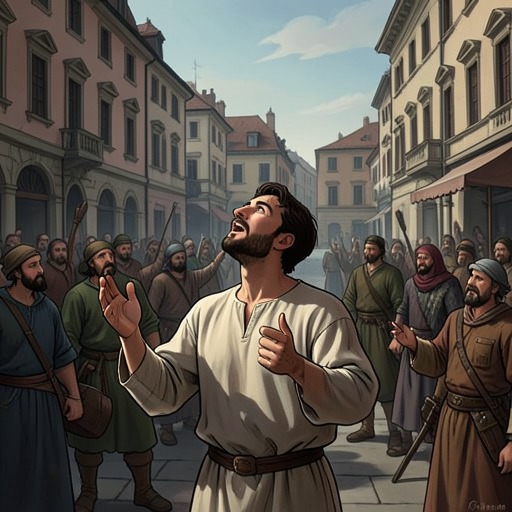
As hostility rises, the demand to send Christians to the lions spreads through the streets. Petronius hears the cry while traveling home from Nero’s court. It is repeated by successive crowds emerging from the burned districts and spreading through streets, alleys, hills, and gardens. The repeated slogan shows how a single accusation can move through a dispersed population and become a common public demand, even while the circumstances of the fire remain contested.
Petronius challenges the court’s attempt to make the Christians a convenient answer to the disaster. He tells Nero and the assembled power holders that they may offer Christians to the arena or impose other punishments, but that they should not deceive themselves: the Christians did not burn Rome. His appeal draws on the difference between persuading the populace and acknowledging the truth among those who govern. The scene establishes that Petronius is certain of the Christians’ innocence even though he does not share their religion, and that he risks speaking because Vinicius, Lygia, and the accused are in danger.
The persecution’s public spectacle does not produce a simple or uniform response. When Ursus defeats the bull in the arena and raises Lygia, the amphitheatre erupts in calls for mercy. The crowd, moved by his strength, presses for his life and freedom; Ursus appears to understand that the appeal concerns him but looks beyond his own survival as he approaches Nero’s podium carrying Lygia. The episode places a collective demand for clemency inside a setting used to display state power and punish Christians. It gives the crowd a capacity for compassion that sharply contrasts with the earlier cry for the Christians’ destruction.
Narrative Significance
The community is represented through concrete acts rather than an institutional description: Lygia refuses hatred, Ursus turns from private retaliation toward seeking counsel, and believers are imagined gathering to help someone escape. The account does not describe a formal structure beyond the reference to Bishop Linus and the anticipated assembly of Christian helpers. What it does show is a network that crosses distinctions among enslaved people, gladiators, and free people, and that depends on ties of belief and trust rather than wealth or imperial office.
The Christian network remains exposed to surveillance and accusation. Chilo’s search exploits the community’s visible sign; the Great Fire supplies a climate in which rumors can harden into a demand for punishment; and Nero’s court can turn that demand toward the arena. Yet the community’s presence also unsettles the logic of spectacle. The public outcry against Christians is followed by the crowd’s appeal for mercy when Ursus saves Lygia. Across these reversals, the Early Christian Community serves as a test of what collective action can mean: mutual protection under persecution, manipulation of public anger by power, and, at moments, a crowd moved to spare rather than condemn.